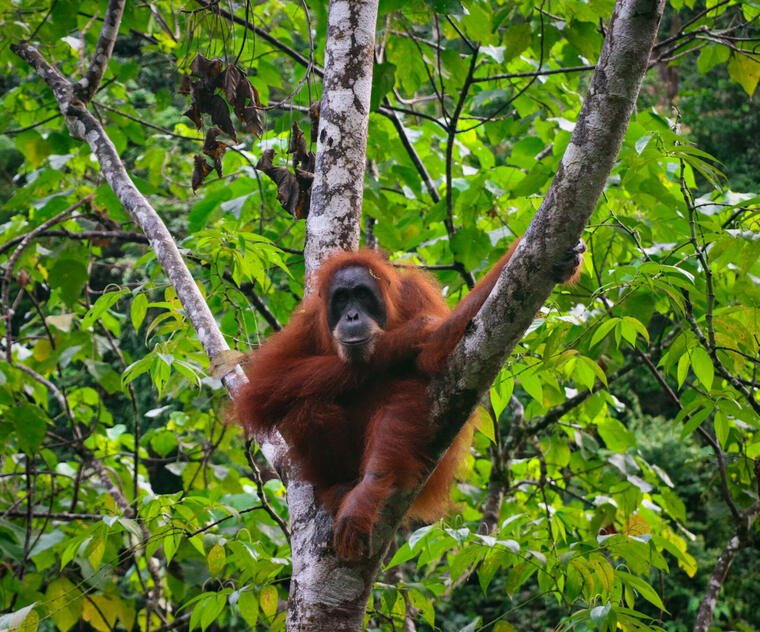
"Orangutan" comes from the Malay words orang (person) and hutan (forest): the person of the forest. Spend an hour watching one and you'll understand the name.
The basics
- Scientific name: Pongo abelii, one of three orangutan species alongside the Bornean and the Tapanuli orangutan.
- Where they live: only in northern Sumatra, almost entirely in the Leuser Ecosystem, which includes Gunung Leuser National Park.
- Status: Critically Endangered (IUCN Red List), threatened mainly by forest loss to palm oil, logging, roads and the illegal pet trade.
- Life in the trees: Sumatran orangutans are the most arboreal great apes. They build a fresh nest of branches to sleep in almost every night.
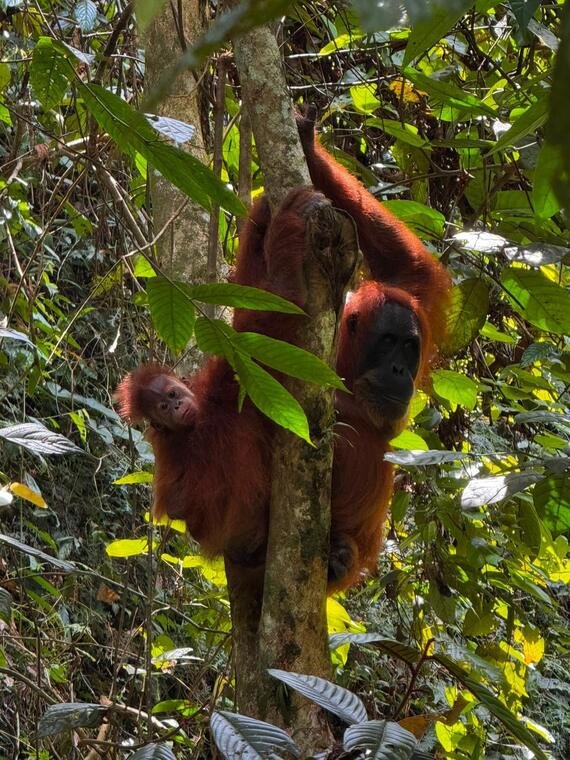
- Slow families: a mother usually has one baby at a time and keeps it with her for many years. The gap between births, often 8 or 9 years, is among the longest of any mammal, which is why populations recover so slowly.
- Diet: mostly fruit, especially figs, plus young leaves, bark, flowers, insects and honey.
Where to see Sumatran orangutans in the wild
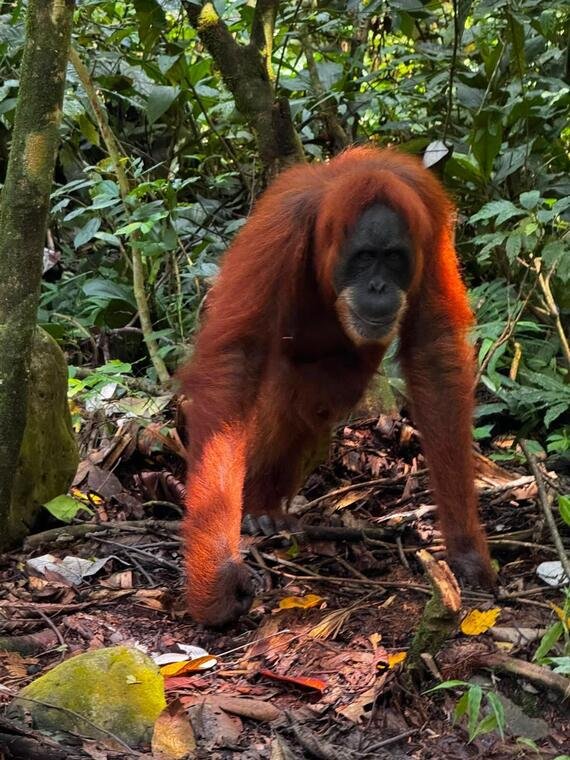
The easiest place is Bukit Lawang. From 1973 the village was home to a rehabilitation centre that returned orphaned and ex-pet orangutans to the forest. Many of the orangutans you meet there today are those animals and their offspring: they live free and feed themselves, but tolerate people nearby. That's why Bukit Lawang has such high sighting rates.
Close by, Batu Katak offers fully wild orangutans in a much quieter forest. Sightings are less frequent, but you may be the only group around.
How to watch orangutans ethically
Orangutans share about 97% of our DNA, so they catch our colds, flu and stomach bugs easily. And an orangutan that learns people mean food can become pushy or aggressive, which ends badly for the orangutan. Every guest on our treks follows these rules:
- Never feed an orangutan, and don't carry open food when one is near.
- Stay at least 10 metres away. Step back if one comes towards you, and never get between a mother and her baby.
- Don't trek if you're sick, and never cough or sneeze towards them.
- Keep your voice low and no flash photography.
- Choose a guide who won't call orangutans in with food. If a guide offers to, say no.
Meet some of the neighbours
Gunung Leuser is the only place where orangutans, Sumatran tigers, rhinos and elephants still share one forest. Tigers and rhinos are almost never seen, but on a trek you might meet Thomas leaf monkeys, white-handed gibbons and siamangs, long-tailed and pig-tailed macaques, hornbills, monitor lizards and several kinds of pit viper. The forest is also home to two botanical giants: the Rafflesia, the world's largest single flower, and the towering Amorphophallus titanum.
How your trek helps
Tourism gives families around the park a reason to keep the forest standing. When you trek with local guides, you're paying people from Bukit Lawang and Batu Katak to protect orangutans rather than clear land for plantations. The long-term dream of our team is to buy land next to the park and keep it as forest for good.